Zurich Insurance Group (ZURN) is a leading global insurer founded more than 150 years ago. It offers a broad range of insurance, retirement, and risk-engineering services to individuals and businesses of all sizes.
The company pays a generous and reliable dividend that may seduce income-oriented investors. Earnings growth expectation on the other hand is much more modest.
All things considered, is the stock a good investment today?
In this Zurich stock analysis, we’ll break down the business using my simple, fundamentals‑driven stock analysis approach to find out whether it deserves a place in a long‑term, disciplined portfolio.
Let’s dive in.
Full disclosure: I don’t own Zurich stocks at the time of writing this analysis.
⚡Key Takeaways
- Zurich is a global insurance company with more than 150 years of existence.
- The company is mature and pays a generous and reliable dividend.
- Fair value estimate suggests the stock is within the fair price interval.
- Final take on Zurich: worth adding to watchlist!
What Does Zurich Do?
Zurich Insurance Group is a Swiss company founded in 1872 that provides insurance products and related services all over the world.
It operates through three key segments:
- Property & Casualty: physical assets and liabilities for individuals and businesses.
- Life: savings, protection, and pension solutions.
- Farmers: management services for the Farmers Exchanges.
The company sells its products through agents, brokers, and bank distribution channels.
Insurances make money in two ways. First, via underwriting margins (premiums received minus claims paid) and, second, via investment returns on float (the pool of money collected from customer premiums).
Stock Price Long‑Term Trend
Zurich’s long-term stock price chart shows a very modest 158.5% return since 1994, that’s just 2.9% annualized growth. Plus, the stock had a dramatic rise-and-fall in the late 90’s.
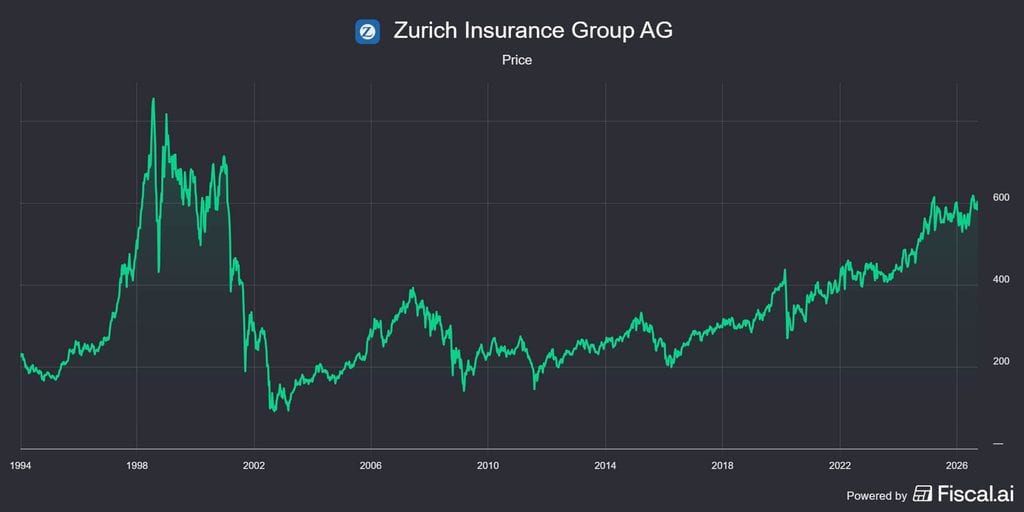
Since then, though, the price as behaved much more reliably, and over the last 10 years annualized growth was 8.8%. Clearly something has changed.
So, is Zurich a reliable company and a good investment?
Let’s have a look into the numbers to find the answer.
Zurich Fundamental Analysis
Let’s explore the fundamentals of Zurich then.
1. Past Performance
Revenue
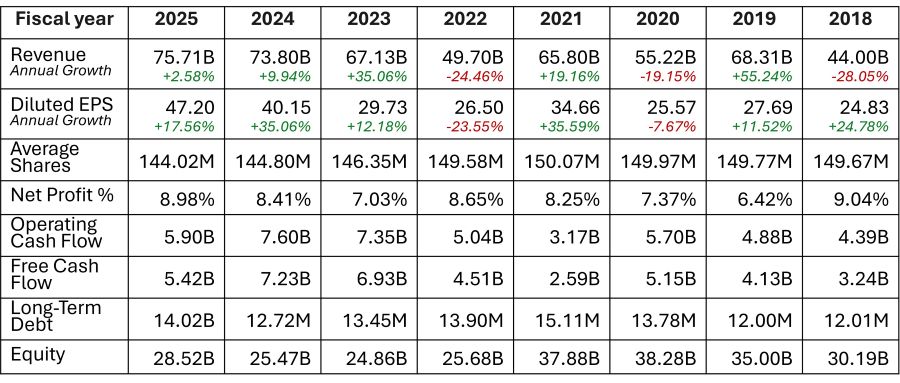
Revenue has increased 72% between 2018 and 2025, from CHF 44.00B to CHF 75.71B, that’s a yearly growth of 8.1%. However, progress has been somewhat inconsistent with some sharp declines and comebacks.
Earnings Per Share
Zurich’s earnings per share behaved in a similar way to its revenues, nearly doubling between 2018 and 2025. The annualized earnings growth was a bit better, reaching 9.6% over the same period.
Share Count
The number of shares outstanding in the market has been reduced by around 3.7% since 2018. But that did not substantially improve the earnings per share performance.
Net Profit Margin
The company’s profit margins have been consistently around 7-9%. That’s within industry average.
Cash Flow
Both operating and free cash flows show a long-term upward trend, but not so much reliable on year-over-year basis.
Seems like Zurich can manage its cash position through business cycles. Just not make it grow substantially.
2. Financial Health
The company is in a reasonable financial position. Debt-to-equity ratio was 49% by the end of 2025, which is ok, and debt levels have been progressing in a controlled way.
3. Dividends
Zurich distributes most of its profits and cash flow as dividends. It currently pays a forward dividend of CHF 30.00 per share, reaching a high yield of 5.1%. And it has delivered a consistent and increasing dividend since 2006.
4. Growth Outlook
Time to jump into my educated guesstimate on Zurich based on past performance and recent trends.
The business has been growing modestly and somewhat inconsistently. Still, it shows a reasonable financial health and manageable debt, while distributing most of its earnings to shareholders as dividends.
Based on fundamentals and reputation, I believe Zurich will continue to prosper and solidify its position. This is a mature, slowish growth company and is hard to forecast more than that.
Therefore, I would expect a moderate 6-10% annual earnings growth over the coming years.
Zurich Fair Value Estimate
Now let’s run our back-of-the-envelope valuation to get a quick and simple assessment.
Owner’s Earnings
First, let’s estimate the total potential return on investment by using the owner’s earnings:
Expected return = future EPS growth (6–10%) + dividend yield (5.1%) ≈ 11–15% per year
If the stock is fairly priced, this is the return an investor might expect.
PEG Ratio
Next, let’s assess whether the stock is trading at a fair price or not.
Just by comparing the current P/E ratio (TTM) of 15x with our owner’s earnings estimate of 11–15% we can see that the stock seems fairly priced:
PEG = P/E ÷ Owner’s earnings = 1.4 to 1.0
From the growth at a reasonable price approach, we know that a PEG equal to 1 suggests that the company is reasonably priced compared to its expected return.
Fair Value Estimate
So, if Zurich was priced in line with its growth (PEG ≈ 1), its P/E should be between 11-15x versus today’s 15x.
This implies the stock currently trades at somewhere between fair price and a 27% premium versus our fair value estimate.
Conclusion: Is Zurich a Good Investment?
Here’s my final take on Zurich: a solid dividend payer, near fair price, and definitely worth adding to our watchlist.
Why? Let’s recap everything.
Does the Company Have Solid Financials?
Yes. Zurich is a profitable company with inconsistent but growing revenue and earnings. It generates positive cash flows, while keeping a decent cash position and manageable levels of debt.
Do I Understand the Business Model?
Yes. Zurich is a global insurance provider that serves both individuals and businesses with a diversified protections offer. It makes money from underwriting margins and investment returns on float. As a mature company, it’s realistic to expect a slowish growth going forward.
Does It Trade at a Fair Price?
Yes. Based on this simple stock analysis, we can say that Zurich is within the fair price interval relative to its expected growth.
👉Action step: Take another look at Zurich using your own assumptions. Do you agree with this assessment, or do you see something I’ve missed? Share your thoughts in the comments — I’d love to hear your perspective.
And if you haven’t yet, subscribe for more fundamentals‑driven stock analyses.