Wise Group plc (WISE) is a rising fintech, founded in 2010, and based in the United Kingdom. It offers cross-border transfers and payments, multi-currency conversions, and account services.
The company is growing fast but the stock price struggles to move above its 2021 IPO mark.
So, is this a good investment or just another hyped trap?
In this stock analysis, we’ll break down the business using my stock analysis framework to find out whether it deserves a place in a long‑term, disciplined portfolio.
Let’s dive in.
Full disclosure: I don’t own any Wise stocks at the time of writing this analysis.
⚡Key Takeaways
- Wise is a global cross-border money transfer and payment services provider.
- The company is growing fast, making good money, and is financially solid.
- Fair value estimate suggests the stock is within the fair price interval.
- Final take on Wise: worth adding to our watchlist!
What Does Wise Do?
Wise Group is a global financial technology company that provides cross-border money transfer and payment services.
The company’s products include:
- Wise Account: a solution for individual customers to send, spend, hold, and get paid in one or more currencies.
- Wise Business: which offers the main features of Wise Account along with business-specific functionalities designed to enable businesses to operate internationally, including managing their accounting and accounts payable and receivables.
- Wise Platform: which enables banks, financial institutions, and enterprises to integrate its international payment infrastructure into their own services.
Wise makes money by charging small transaction fees, generating interest on customers balances, card charges and providing business-related services.
Stock Price Long‑Term Trend
Wise stock only went public in mid-2021 so there isn’t much to say about its price long-term trend really. The starting price was £8.00 and is only sightly up to this day.
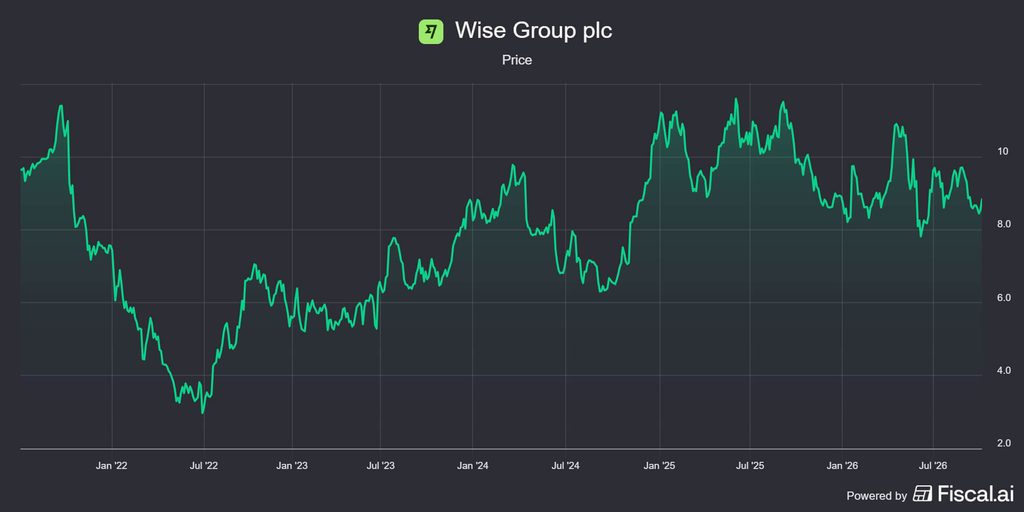
Like most IPO’s, the price fell not long begore its debut. And we have been witnessing a volatile recovery since then. It’s still too soon to draw any conclusions from the price trend alone.
So, can the fundamentals tell a clearer story?
Let’s have a look into the numbers to find the answer.
Wise Fundamental Analysis
Let’s explore the fundamentals of Wise.
1. Past Performance
Revenue
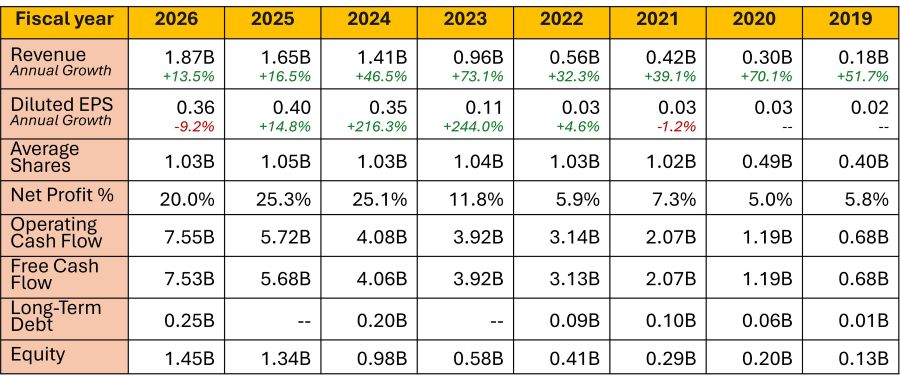
The company’s revenue has increased over 9x times between 2019 and 2026, from £0.18B to £1.87B, that’s a yearly growth of 39.9%. It seems, though, that it may be losing is speed when looking at the two last years.
Earnings Per Share
Wise’s earnings per share, in turn, have increased 17x times over the same period. But they behave in a much less reliable way, taking some big swings and the occasional regression.
Share Count
Since going public in 2021, the total number of shares in the market did not change in a meaningful way.
Net Profit Margin
The company’s profit margins have improved greatly, from around 5% up to 20-25%. That’s the power of business scale more than anything else.
Cash Flow
Operating and free cash flows go together and have increased 10x times between 2019 and 2026. This way, Wises has been able to accumulate a substantial cash balance over time.
2. Financial Health
The company is in a good financial position. Debt-to-equity ratio was just 17% by the end of 2026 and debt has historically been kept under control.
3. Dividends
Wise has never distributed dividends and it’s not likely to do it any time soon. The company is directing all available funds into growing an expanding the business.
4. Growth Outlook
Time to jump into my educated guesstimate on Wise based on past performance and recent trends.
The business has been growing fast, although showing some signs of slowing down. Still, it has enough available market share and financial strength to continue pushing for expansion.
There’s still room for growth in new geographies and partnerships. Most Wise’s active users are personal customers, but business customers (SME’s) are catching up and can drive higher cross-border activity.
Therefore, I would expect a reasonable 15-25% annual earnings growth over the coming years. It’s a wide range but, as we’ve seen, so it is the historical data.
Wise Fair Value Estimate
Now let’s run our back-of-the-envelope valuation to get a quick and easy assessment.
Owner’s Earnings
First, let’s estimate the total potential return on investment by using the owner’s earnings:
Expected return = future EPS growth (15–25%) + dividend yield (0%) ≈ 15–25% per year
If the stock is fairly priced, this is the return an investor might expect.
PEG Ratio
Next, let’s assess whether the stock is trading at a fair price or not.
When we compare the current P/E ratio (TTM) of 24x with our owner’s earnings estimate of 15–25%, we can see that the stock is within the upper limit of fairly priced:
PEG = P/E ÷ Owner’s earnings = 1.6 to 0.9
From the growth at a reasonable price approach, we know that a PEG equal to 1 suggests that the company is reasonably priced compared to its expected return.
Fair Value Estimate
So, if Wise was priced in line with its growth (PEG ≈ 1), its P/E should be between 15-25x versus today’s 24x.
This implies the stock currently trades at somewhere between fair price and a 60% premium versus our fair value estimate.
Conclusion: Is Wise a Good Investment?
Here’s my final take on Wise: although we would like to have a bigger margin of safety, it’s still worth adding to our watchlist.
Why? Let’s recap everything.
Does the Company Have Solid Financials?
Yes. Wise has a profitable and growing business, even though it shows some signs of slowing down. It generates positive cash flows, while keeping a decent cash position and low levels of debt.
Do I Understand the Business Model?
Yes. Wise is a global financial technology company that provides cross-border money transfer and payment services. It makes money from small transaction fees, interest on customers balances, card charges, and business services.
Does It Trade at a Fair Price?
Yes. Based on this simple stock analysis, we can say that Wise is within the upper limit of our fair price interval relative to its expected growth.
👉Action step: Take another look at Wise using your own assumptions. Do you agree with this assessment, or do you see something I’ve missed? Share your thoughts in the comments — I’d love to hear your perspective.
And if you haven’t yet, subscribe for more fundamentals‑driven stock analyses.