LVMH (MC) owns some of the most recognized luxury brands in the world, from Louis Vuitton and Dior to Tiffany & Co., Moët & Chandon, and Hennessy. It’s also one of Europe’s most valuable companies.
But is this luxury business a wise investment today?
In this LVMH stock analysis, we’ll break down the business using my simple, fundamentals‑driven stock analysis approach, and find out why it’s not just its products that sell at a premium rate.
Let’s dive in.
Full disclosure: I don’t own LVMH stocks at the time of writing this analysis.
⚡Key Takeaways
- LVMH is a global luxury powerhouse with iconic brands across fashion, jewelry, beauty, and wines & spirits.
- Revenue and earnings grew ~10% on average, but have been slowing down recently.
- Financial health is strong: low debt, rising cash flows, and a long history of dividend increases.
- Fair value estimate suggests overvaluation with the stock trading at a 38–62% premium.
- Final take on LVMH: too expensive! It’s a good business but not necessarily a great investment at today’s price.
What Does LVMH Do?
LVMH is a France-based company and the world’s leading luxury multi-brand goods conglomerate.
The company operates across several segments, including fashion and leather goods with brands such as Louis Vuitton, Christian Dior, Marc Jacobs, and Givenchy; watches and jewelry segment includes brands such as Bvlgari, TAG Heuer, Zenith, and Tiffany & Co.
It offers perfumes and beauty products from Christian Dior, Guerlain, Loewe, Kenzo, Make Up For Ever, and Acqua di Parma. And its wines and spirits division includes products like Dom Pérignon, Hennessy, and Moët & Chandon.
Beyond luxury goods, LVMH also owns media, hotels, and yacht‑building businesses, reinforcing its position as a diversified luxury ecosystem.
Stock Price Long‑Term Trend
LVMH’s long-term stock price chart shows 40+ years of volatile growth with a few sharp declines along the way. The stock peaked in mid-2023 before falling back to early-2021 levels where it stands today.
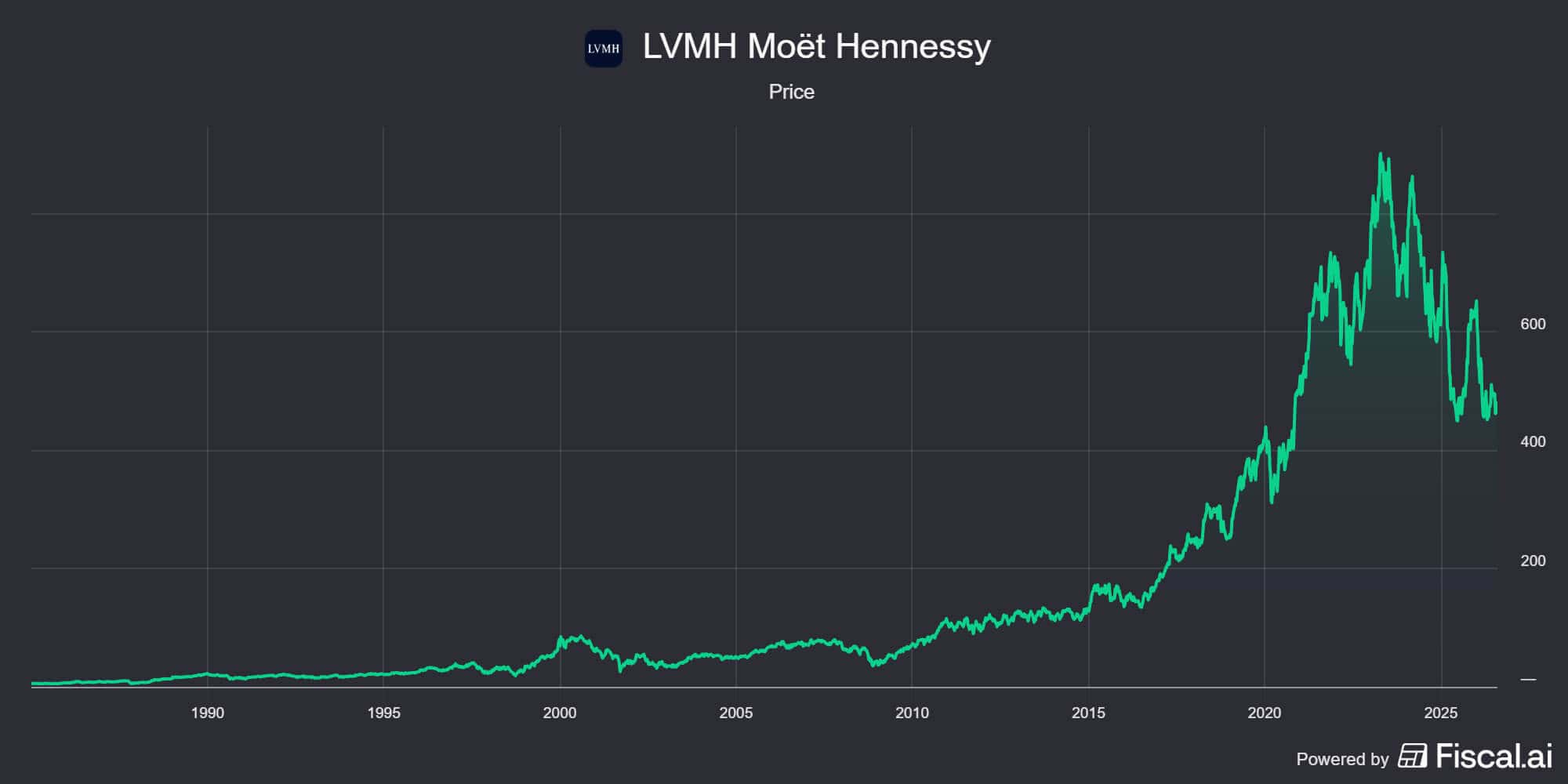
This raises some questions about business growth and sustainability over time.
And to find the answers we need to look into the business financials and follow its earnings past performance.
LVMH Fundamental Analysis
Let’s explore the fundamentals of LVMH then.
1. Past Performance
Revenue
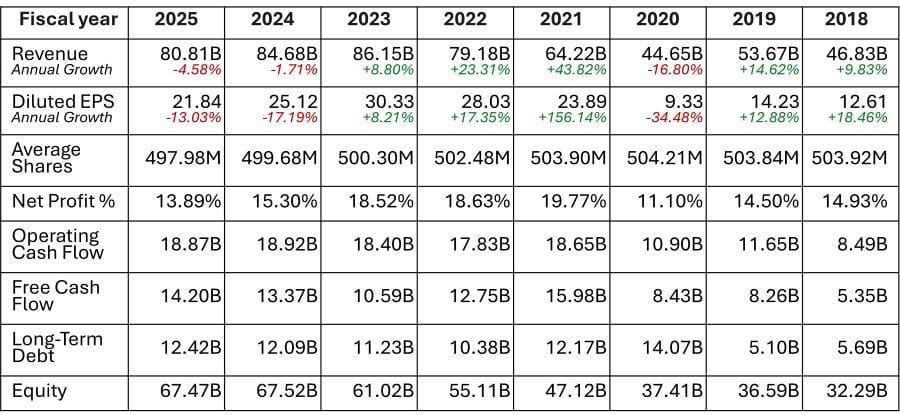
Revenue nearly doubled between 2018 and 2023 when it peaked at €86.15 B, just before dropping to €80.81 B in 2025 fiscal year. It’s not a very consistent performance. Still, that’s roughly a 10% yearly growth on average.
Earnings
LVMH’s earnings per share show a similar performance and 10% annual growth overall.
Share Count
The number of shares outstanding in the market was slightly reduced from 503.92M to 497.98M between 2018 and 2025. Not enough to really make a significant impact, just see how profit growth and earnings per share growth are the same.
Net Profit Margin
Though with some variation, net profit margins circled around 14% over the same period. Quite decent I must say, but I would expect more from a luxury business with a premium pricing model.
Cash Flow
Both operating and free cash flow show a clear upward trend, having more than doubled between 2018 and 2025.
LVMH knows how to make money out of its brands and build a strong cash position over time.
2. Financial Health
The company is in a strong financial position.
2025’s debt-to-equity ratio sits well under the 30% ideal threshold. Plus, long-term debt has been steady since 2021 while shareholders’ equity kept growing.
3. Dividends
LVMH pays a forward dividend of € 13.00 per share, yielding a notable 2.7%. And it has delivered a consistent and increasing dividend for more than twenty years.
4. Growth Outlook
Past Growth
We’ve seen that both revenues and earnings per share increased around 10% annually between 2018 and 2025. Though, this growth was quite inconsistent year-over-year and even contracting over the last two fiscal years.
Future Expectations
Time to move on to my educated guesstimate on LVMH based on past performance.
The company’s growth rate has been unreliable and shows early signs of contraction. Yet I don’t believe that LVMH and its unique luxury brands will stop expanding, they will just do it at a slower pace.
For that reason, I would expect a conservative 5-10% annual earnings growth over the coming years. That puts the company near the “stalwart” category.
LVMH Fair Value Estimate
Now let’s run our back-of-the-envelope valuation assessment. The aim is to get an approximation interval through quick and simple calculations.
Owner’s Earnings
First, we estimate the total potential return on investment by using the owner’s earnings. This is nothing more than adding the expected future growth of earnings per share and the forward dividend yield.
Expected return = future EPS growth (5–10%) + dividend yield (2.7%) ≈ 8–13% per year
If the stock is fairly priced, this is the return an investor might expect.
PEG Ratio
Next, let’s assess whether the stock is trading at a fair price or not using the PEG ratio.
When we compare the current P/E ratio (TTM) of 21x with our owner’s earnings estimate of 8–13% it triggers overpriced right away.
PEG = P/E ÷ Owner’s earnings = 2.6 to 1.6
From the growth at a reasonable price approach, we take that a PEG above 1 suggests overvaluation. And a PEG above 2 suggests the stock is way too expensive for the return it offers.
Fair Value Estimate
If LVMH was priced in line with its growth (PEG ≈ 1), its P/E should be between 8–13x versus today’s 21x.
This implies the stock currently trades at a premium of 38-62% versus our fair value estimate.
Conclusion: Is LVMH a Good Investment?
Here’s my final take on LVMH: a renowned European luxury company but unfortunately, it’s just too expensive.
Why? Let’s recap everything.
Does the Company Have Solid Financials?
Yes. LVMH is a revenue and profit growing company even if they’re inconsistent and slowing down. It generates positive and growing cash flows that lead to a strong cash position and low levels of debt.
Do I Understand the Business Model?
Yes. Luxury brands have always been object of desire and a very resilient business overall, although somewhat cyclical.
It seems fair to expect that premium products and signature brands will continue to enjoy distinctive demand. Consumers’ recognition and trust holds very strong.
That gives me conviction that LVMH will continue to grow, even if at a slower pace, over the long term.
Does It Trade at a Fair Price?
No. Based on this simple stock analysis approach, we can clearly say that LVMH is way overpriced relative to its expected growth. The stock trades at a premium of 38-62% versus our fair value estimate.
👉 Action step: Take another look at Novo Nordisk using your own assumptions. Do you agree with this assessment, or do you see something I’ve missed? Share your thoughts in the comments — I’d love to hear your perspective.
And if you haven’t yet, subscribe for more fundamentals‑driven stock analyses.
After analysing 3 different companies, I see how important it is to discover a fair value that the stock is trading at, and essentially calculate the PEG ratio together with an Expected return….which identifies slow growth or a stalwart.