ASML Holding NV (ASML) is often described as Europe’s crown jewel — the company that makes the machines that make the chips. It’s also one of the most admired stocks among European investors.
But admiration doesn’t automatically translate into a good investment.
In this ASML stock analysis, we’ll break down the business using my simple, fundamentals‑driven stock analysis approach, and find out why it’s a great business but not necessarily a great investment at today’s price.
Let’s dive in.
Full disclosure: I don’t own ASML stocks at the time of writing this analysis.
⚡Key Takeaways
- ASML is one of Europe’s highlighted businesses, playing a key role in the complex chipmaker’s ecosystem worldwide.
- It’s a fast growing company with double-digit margins, strong cash position and low levels of debt.
- The biggest risk isn’t the financials — it’s whether we truly understand ASML’s highly complex technology and long‑term competitive position.
- Using my simple stock analysis approach, ASML’s fair value estimate should be roughly 50% below its current market price and P/E ratio (TTM) of 45x.
- My final take on ASML: too expensive! It’s a great business but not necessarily a great investment at today’s price.
What Does ASML Do?
In short, ASML provides chipmakers with everything they need – hardware, software and services – to mass produce patterns on silicon through lithography.
But let’s take it a step further.
“The company (…) engage(s) in development, production, marketing, sales, upgrading and servicing of advanced semiconductor equipment systems, consisting of lithography, metrology and inspection systems.
The Company offers TWINSCAN systems, equipped with lithography system with a mercury lamp as light source (i-line), Krypton Fluoride (KrF) and Argon Fluoride (ArF) light sources for processing wafers for manufacturing environments for which imaging at a small resolution is required.“ — MSN Money
If your brain just melted, you are not alone. Most investors — myself included — can only understand ASML’s technology at a high level.
In order to have high conviction when investing you need to know what you own and why you own it. Remember that.
Stock Price Long‑Term Trend
ASML’s stock has followed a strong long‑term upward trend, although recent years show increasing volatility.
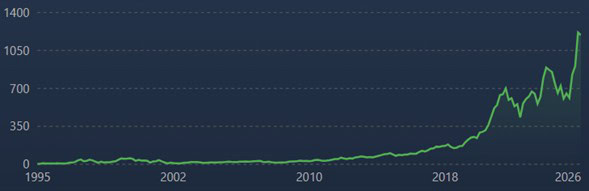
The key question about recent swings is whether they reflect changes in earnings, or changes in market sentiment about ASML’s future.
And since stock prices follow earnings over the long term, this distinction matters.
ASML Fundamental Analysis
Now let’s break down the business using fundamentals.
1. Past Performance
Revenue
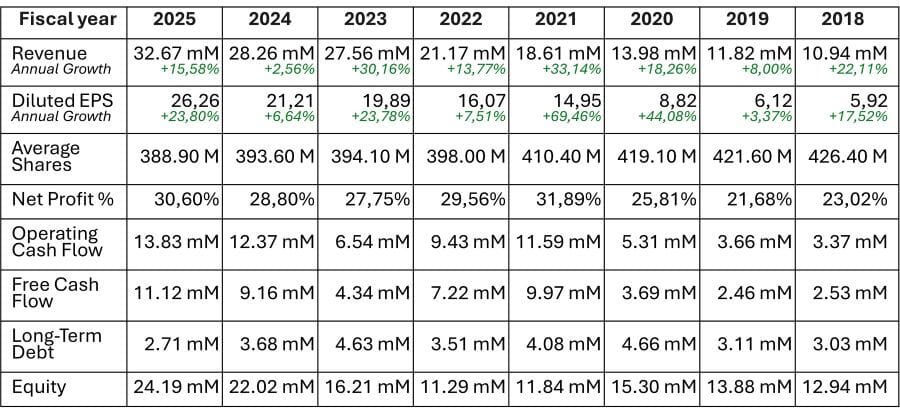
Revenue has been growing consistently between 2018 (€10.94 mM) and 2025 (€32.67 mM). The average annual growth is roughly within the 15–20% rate, which is quite good for a company of this size.
Earnings
Its earnings per share grew even faster at roughly 20-25% annually. But what could explain that difference? Two reasons: share buybacks and margin expansion.
Share Count
Between 2018 and 2025, the number of shares outstanding in the market was reduced from 426M to 389M. Therefore, the pie (earnings) is now split into fewer pieces (shares). Fewer shares = higher earnings per share.
This can also be seen when comparing the net profit growth versus the earnings per share growth. The latter does perform better.
Net Profit Margin
In 2018 the net profit margin was 23% but by 2025 it grew to nearly 31% meaning ASML is making more money for each euro in revenue. This is a sign of strong competitive advantages and pricing power.
Cash Flow
Looking into both operating and free cash flow, we can spot a clear upward trend meaning that ASML isn’t just profitable on paper — it generates real money. This also leads to a very solid cash position in their balance sheet.
2. Financial Health
The company is in a strong financial position.
2025’s debt-to-equity ratio sits well under the 30% ideal threshold. Plus, we can see that since 2018, long-term debt has been going down while shareholders equity has been going up.
All the good signs of a company that has solid financials to face the future.
3. Dividends
ASML pays a 7,50€ forward dividend per share, yielding only 0,65%. It’s negligible.
4. Growth Outlook
Past Growth
As I have mentioned above, revenues grew around 15-20% annually while earnings per share were up roughly 20-25%. Both always trending upward, though somewhat inconsistent.
Future Expectations
Time to make an educated guess based on past performance.
It’s debatable whether ASML will continue to buyback its shares over the long-term. And the same can be said about its ability to keep raising profit margins consistently.
But assuming the optimistic scenario, let’s lay it can continue to grow earnings 20-25% annually. That keeps the company in the “fast grower” category.
ASML Fair Value Estimate
Now we step into our back-of-the-envelope valuation assessment. The goal is to get an approximation interval through quick and simple calculations.
Owner’s Earnings
Let’s start by estimating the total potential return on investment by using the owner’s earnings. This is nothing more than adding the expected future growth of earnings per share and the stock forward dividend yield.
Expected return = future EPS growth (20–25%) + dividend yield (0,65%) ≈ 21–26% per year
This is the return you’d expect as an investor if the stock is fairly priced.
PEG Ratio
So, let’s assess whether the stock is trading at a fair price or not using the PEG ratio.
If we compare the stock current P/E ratio (TTM) of 45x with our owner’s earnings estimate of 21-26% we can see instantly that we are in overpriced territory.
PEG = P/E ÷ Owner’s earnings = 1,7 to 2,1
And from Peter Lynch’s growth at a reasonable price approach, we know that a PEG above 1 suggests overvaluation. And a PEG above 2 suggests the stock is way too expensive for the return it offers.
Fair Value Estimate
If ASML were priced in line with its growth (PEG ≈ 1), its P/E should be somewhere between 21–26x, not 45x.
This implies the stock should trade at roughly 50% its current price.
Conclusion: Is ASML a Good Investment?
Here’s my final take on ASML: a great European business but unfortunately, it’s just too expensive.
Why? Let’s recap everything.
Does the Company Have Solid Financials?
Yes. ASML is a revenue and profit growing company with a double-digit margin. It generates positive and growing cash flows that lead to a strong cash position and low levels of debt. The numbers also suggest the existence of a strong competitive advantage.
Do I Understand the Business Model?
Not really. This one is naturally very specific to me. I do understand the basics, but not the technology or whether ASML position in the market is defensible over the long-term.
This is most relevant to estimate the expected business growth rate with a higher degree of confidence. And that is the foundation of our valuation.
Does It Trade at a Fair Price?
No. Based on this simple stock analysis approach, we can clearly say that ASML is way overpriced and should be trading at 50% its current price.
👉 Action step: Take another look at ASML using your own assumptions. Do you agree with this assessment, or do you see something I’ve missed? Share your thoughts in the comments — I’d love to hear your perspective.
And if you haven’t subscribed yet, now’s the time. Your future self will thank you.